

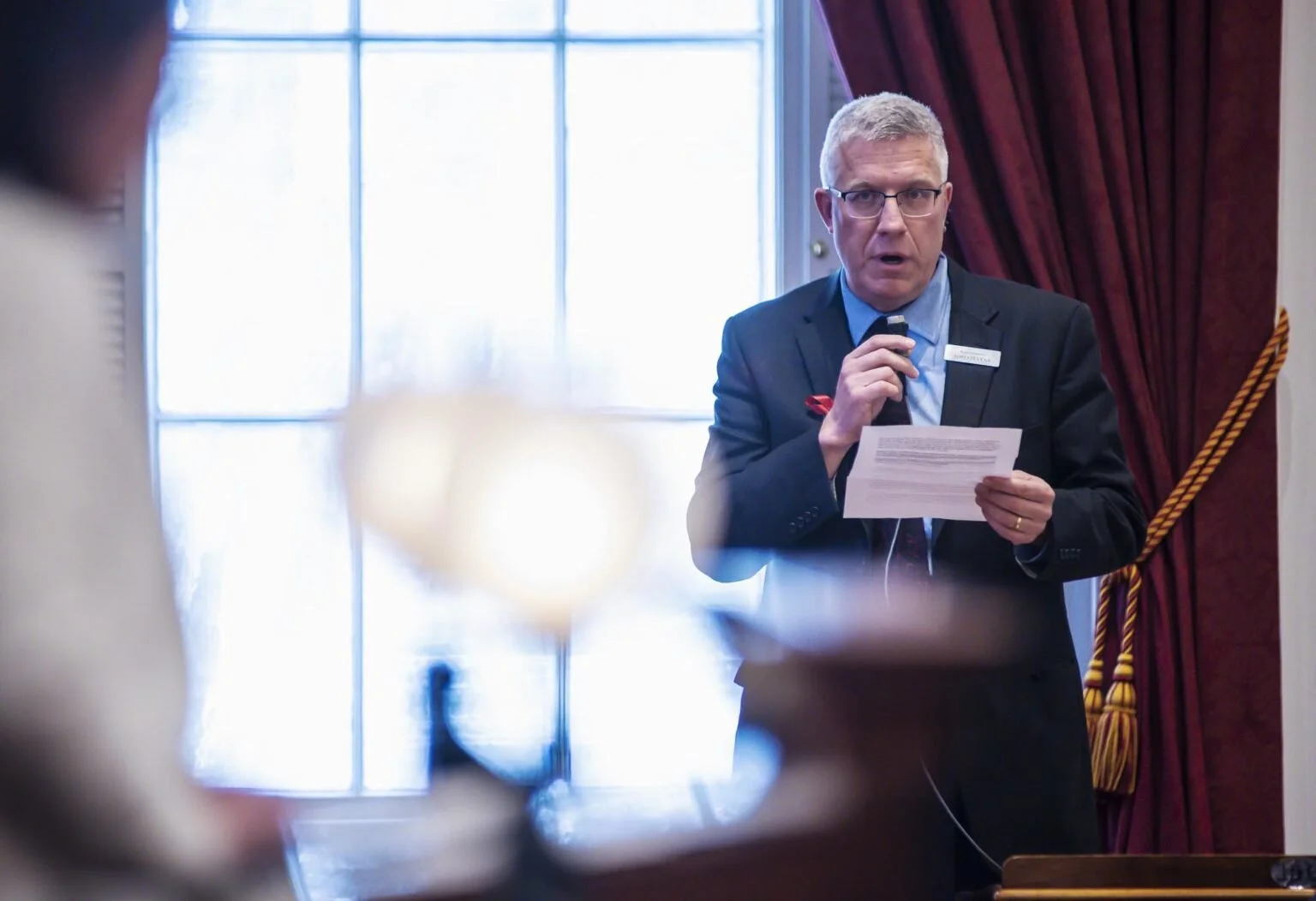
VT House Committee Unanimously Favors Apologizing for Eugenics Movement
Several lawmakers choked up Friday afternoon as a House committee unanimously signed off on a bill apologizing for Vermont’s role in the eugenics movement. “If I don’t accomplish anything else in the Legislature, I’m so happy to have been part of this,” said Rep. Tommy Walz, D-Barre.

Danville VT School Board Says Goodbye to Indians Mascot
Another school in Vermont is changing its mascot. In a 4-1 vote, the Danville School Board said goodbye to the “Danville Indians” Tuesday. But for one school board member, changing the school identity was no easy task. “This was definitely the hardest decision I have ever had to make as a school board member,” said School Board Chair Bruce Melendy.

Mohegan Chief Lynn Malerba on the National Lack of Awareness of Native History
Mohegan Chief Lynn Malerba presents this video, produced by the U.S. Commission on Civil Rights & shared with The United South and Eastern Tribes, focusing on The Broken Promises Report and the lack of public awareness regarding Native American History.

Second Speaker in the CCV Series: Chief Donald Stevens
Community College of Vermont has convened a three-part series of Abenaki speakers this year, hosted online. The second speaker, Don Stevens - Chief of the Nulhegan Band of the Coosuk Abenaki Nation - presented on Thursday, March 18th, and the video recording is linked below

Sugaring in Wabanahkik: An Abenaki History of Maple
Maple sugaring had been practiced by many Indigenous communities across North America before the arrival of Europeans, including the Abenaki people of Vermont, who have resided in the northeast since the glaciers receded an estimated 11,000 - 10,000 years ago at the end of the last Ice Age. Long before the arrival of European explorers and French missionaries, Abenaki peoples followed a multi-step process for collecting and condensing sugar maple sap into sweeteners; a process refined and passed down orally from one generation to the next.

First Speaker in the CCV Series: Jesse Bowman Bruchac
Community College of Vermont has convened a three-part series of Abenaki speakers this year, hosted online. The first speaker, language keeper, musician, author, and artist Jesse Bowman Bruchac (Nulhegan Abenaki) has presented already and the video record is linked below.

Traditional Cultural Properties Discussion from CRC’s LiveStream Series
Join CRC and partners, Rich Holschuh – Atowi Project, David Brule & Joe Graveline – the Nolumbeka Project and Janel Nockelby – MA DCR Great Falls Discovery Center, in this follow-up to our January LiveStream presentations on hydropower relicensing. This month's theme is traditional cultural properties.

Wabanaki Perspective on Kennebec River Damming
For millennia, the Kennebec River was the nucleus of Wabanaki food-systems, diplomacy, and ceremonial life. After hundreds of years of industrial development, it has become unsustainable for Wabanaki peoples and our aquatic relatives alike. The future of Atlantic Salmon and several other sea-run fish now hinges on the restoration of this waterway.

Moose Nose Hash: Jessee Lawyer and Native Cooking
Cooking this way, using traditional Abenaki foods and techniques, gives Lawyer a feeling of fulfillment and honor, and it’s a continuation of his relationship with his ancestors. But, for the most part, indigenous voices haven’t been part of the local food conversation since the time of colonization, when the people who were already living here were pushed aside by European settlers.

Abenaki Storytellers of N’dakinna
In case you missed this live event last week, here's the archived YouTube video of "#Abenaki Storytellers of Ndakinna", from South Hero Land Trust.

What’s In a Name? Sarah Galbraith in the Barre Times-Argus
Recently, on a ski near my home, it hit me: There is a history that stretches far beyond the relatively recent colonial settlement of Vermont, and I know little to nothing about it. Around that same day, I noticed a friend on Facebook was tagging her own ski outings with the location marker “ancestral lands of the Wabanaki Confederacy.” I wanted to know more and began looking around for a history lesson.

Vermont Conversation: An Overdue Apology for VT’s Campaign of Forced Sterilization
An in-depth examination of Vermont's Eugenic Survey and its lasting effects, in the series from VTDigger - an official apology for which is being considered by the legislature, in the form of JRH2

90 Years Later, VT Lawmakers Propose Eugenics Survey Apology
A eugenics survey in Vermont sought to “breed a better Vermonter” by sterilizing and institutionalizing Indigenous people, French-Canadians, and people who were mixed-race, poor or disabled. Ninety years after the 1931 survey got underway, lawmakers are proposing an official apology for the state-supported program that tore families apart. Abenaki people in Vermont say the ripple effects of the eugenics movement are still felt today and an apology from the state is an important step in repairing the relationship.

Louis Cook, a Black Abenaki Man, Shaped U.S. and Akwesasne History
Like many notable historical figures, Atiatoharongwen was cited as having a sharp mind. At eight, he learned the customs and history of Kahnawake, and took up religion and politics. He was fluent in Mohawk, Abenaki, as well as English and French, which helped him in diplomacy with notable figures like George Washington, Louis-Joseph Montcalm, Pontiac, and Richard Montgomery.

Abenaki Place Names Reverberate at Brave Little State on VPR
The listener-sourced investigative podcast series known as Brave Little State, a regular feature on Vermont Public radio, carried a well-received episode this week. In answer to a listener who wondered “how to do their place-name pronunciation homework” preparatory to moving to the state, the hosts compiled audio files contributed by other listeners explaining the “proper, local” enunciations of familiar toponyms. In a welcome inclusion, traditional Abenaki referents were included alongside more familiar contemporary labels.

Rutland High Teams Switch from ‘Raiders’ to ‘Ravens’
Rutland High School has a new mascot. The city’s Board of School Commissioners voted 6-4 on Tuesday to approve the “Rutland Ravens,” a name that a group of Rutland High School students selected after seeking suggestions from city residents and other students in the district.

Circle of Courage, Endangered Alphabets Project Partner on Abenaki Dictionary
A partnership between Abenaki tribal members and the Endangered Alphabets Project has created an illustrated Abenaki dictionary for schools, the Endangered Alphabets Project announced last week.
According to their announcement, the Burlington-based Endangered Alphabets Project partnered in 2019 with the Abenaki Circle of Courage, a youth group associated with the Missisquoi Abenaki Nation, to publish N’Dakinna: An Illustrated Abenaki Dictionary for Schools.
Nulhegan Abenaki Post Statement on Abenaki Ethnocide
The Indigenous Abenaki people of the Northeast have, for generations, been subjected to both genocidal attacks (killing of people) and ethnocidal attacks (killing of culture) by colonial settlers and their descendants. In the colonial era, these threats took the form of murderous attacks on families and villages in war-time. In the modern era, these threats have included eugenic sterilization, forced separations of children and families, misrepresentations of history, and other attacks that the United Nations classifies as “ethnocide.”

Modern Maps Don’t Have a Memory
modern maps hold no memory of what the land was before. Few of us have thought to ask what truths a map may be concealing, or have paused to consider that maps do not tell us where we are from or who we are. Many of us do not know the stories of the land in the places where we live; we have not thought to look for the topography of a myth in the surrounding rivers and hills. Perhaps this is because we have forgotten how to listen to the land around us.

Ice Fishing: Culture, Community, and Conservation
This online panel will look at the cultural, social, and environmental issues surrounding ice fishing, what it means to those who participate in it, and how it may continue to evolve and change in the future. This event is presented in connection with BMAC’s ICE SHANTIES: FISHING, PEOPLE & CULTURE, and ERIK HOFFNER: ICE VISIONS.